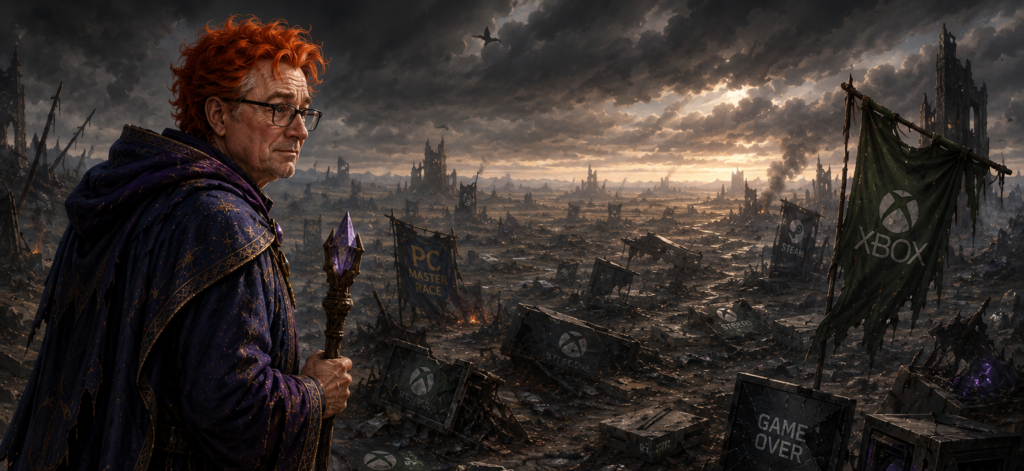
Wolfy had some words to say about the difficult news coming out of Microsoft recently. Thousands of layoffs, studios being closed, games cancelled: it is tragic. My familiarity with the specifics of the Microsoft situation is limited, but I do have some more general thoughts on where the industry is and where it might be going.
Recent events
The Microsoft situation is just one of many events playing out in the games industry of late. I could probably spend a week researching and write a ten page essay just for this section alone, but I’m lazy so here is a brief summary off the top of my head:
- Microsoft: The gaming division of Microsoft has sunk over $60 billion into the Activision acquisition. This put an unrealistic set of expectations on that group to outperform, especially in light of a simultaneous focus on games-as-a-service via Xbox Live. The revenue may have grown, but it couldn’t meet expectations without terrible sacrifice leading to over 3,000 employees being laid off
- Sony: Sony’s push into live service over all other forms of gaming media caused huge losses and upheaval. Concord in particular cost over $100 million and barely lasted a week after release into a market with limited appetite for pay-to-loot hero shooters. Studios were closed, and over 1,000 people lost their jobs
- EA: Electronic Arts is in the midst of a heavily leveraged buyout whereby they are being acquired by Saudi Arabia’s public investment fund and others. It is widely expected that this buyout will be immediately followed by attempts to reduce debt via layoffs, divestments, and studio closures
- Embracer Group: This was a tale of aggressive growth driven by unrealized partnership plans. Embracer Group spent billions buying up small and medium sized gaming companies to make themselves attractive to another Saudi investment fund, expecting billions in investment that never came. The whole Embracer house of cards collapsed taking a dozen or more vaunted studios down with them. Over 4,000 gaming related jobs were lost in the process
Clearly, what Microsoft has done in terms of a slash and burn strategy towards their indentured… er, valued staff is not unique to them. Employees in the gaming industry are treated very poorly by executive teams across the board, and it has to be taking a tremendous toll on the individuals and groups involved. But what is the cause of this self-destructive activity?
What is the cause
The games industry has grown to vast proportions in the past two decades. It now exceeds the movie industry in size by a factor of about five to one- gaming brings in about $200 billion a year in revenue, whereas movies barely exceed $40 billion. This monetary value brings in different players than used to be involved in the industry.
The gaming business used to have more visionaries in leadership roles than business people. These were people who played and loved games and who wanted to make more great games to play. Many of the companies weren’t publicly traded or, if they were, their leadership was given broad latitude in decision making. Few of the business people of the time thought they understood how to make more money from games, at least not to the extent they do now.
In recent years the sheer size of the gaming industry has attracted more and more business people. MBAs, Harvard graduates: that kind of toff, young enough to seem plausible as gamers, wearing a fancy enough suit to get into the C-suite. They were given ever greater control as they found better and better ways of squeezing more money out of the games they sold. In that sense, a purely financial sense, they were successful. I would say that Electronic Arts is the poster child for this kind of shift in focus. It reached a fever-dream peak with live service games like Fortnight and Roblox and the entire mobile games industry.
But recently the perpetual growth machine that has been gaming has started to hit a wall. The tolerance of gamers for games that aren’t really fun has started to wane. There is still money to be made in live service entertainments, but only a small minority of such games have been successful. Games like Concord and Suicide Squad: Kill the Justice League only make money if the people play the games and buy the virtual loot that pays the bills. As evidenced by the complete faceplants both of these afore mentioned games experienced, such games are not guaranteed success.
Less profitable games that lack 90% margins from selling virtual hats are more popular with the gamers themselves, but they don’t generate the same kinds of revenue streams the flawed business models predict. A game that sells 2 million copies is a ‘failure’ if it costs nearly $200 million to make and was budgeted for 12 million copies sold.
The industry can’t sustain these kinds of numbers as a normal business plan. The executive teams have set false expectations, and to keep the gravy train flowing they have to keep the numbers going up. Layoffs are a quick and cowardly way to accomplish that goal.
Where next
I feel like we are going through the tail end of a market correction. I don’t doubt that stupid executives will carry on being stupid- it seems to be their thing. But enough has happened for at least a few smart people to start to adjust their business models and projections. If I’m right, the pressure on the studios will start to be reduced and profit expectations will begin to more closely hew to reality.
I also always see good things from various development studio heads. The folks at CD Project Red, the teams working on Bethesda games, the upcoming Fable reboot progress reports, and many others give me faith that good developers are still being given some kind of semi-healthy work environments to create within. There are people in leadership roles at various places in the industry who still care about making good games; people who keep a rein on unreasonable profit expectations. There is a lot of bad news, to be sure: but hopefully the drumbeat of negative outcomes can start to grow more distant if not entirely silent.
The header image for this post was AI generated using ChatGPT