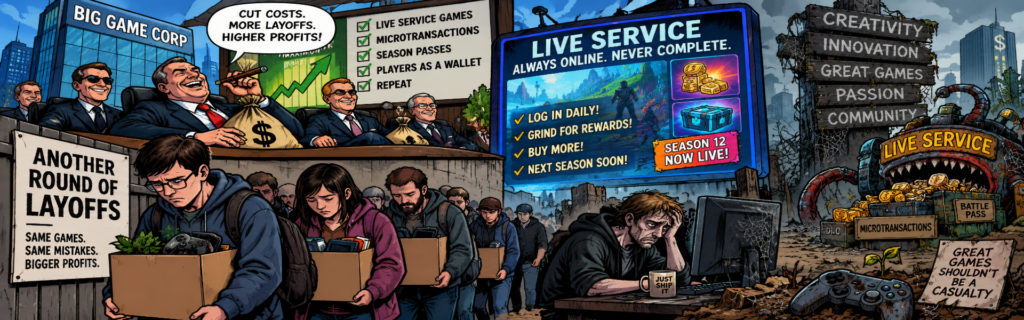
If I had made the headline a question then you could invoke Betteridge’s Law of Headlines and just answer “No”. But I made it a statement because I think the proof is fairly robust: the game industry is sick, and not in a good way. Note that I’m not implying that there are no good games or that the industry is collapsing, but rather that the industry is not consistently rewarding the right kinds of behaviour and products. We are seeing good game developers and designers suffer and be driven out of an industry they used to love by poor Executive decision making and excess focus of profit.
Punishment for success
I started thinking about this topic after reading Blockade85’s post a couple of years ago during Blaugust 2024. I didn’t comment at the time because I was measuring the quality of my posts based on word count and wasn’t sure I had enough words to add. But I think I have some good summation thoughts now to offer: and shorter is often better, after all.
I also watched a GameInformer video that covered a few things that died during 2024. I’ll embed it here for your review:
Things have not gotten better since 2024: thousands of game developers have been laid off each year despite the companies they work for being highly profitable. One of the key things that Blockade85 touched on was the concept of game companies being “punished” with cuts to funding followed by layoffs after successful game releases. I have seen this time and time again, with developers and designers treated like disposable resources immediately after a game ships. There seems to be no effort expended to keep teams together and navigate onto the next project: just toss them in the trash pile and move on.
A lot of this can be blamed on a management team structure that often no longer includes game designers and visionaries. Most large game companies seem to be led by typical MBAs and bean counters. They are stuck with the idea that rapid cost reduction is the best path to the only measure of success that matters: profit.
Creative teams need to be maintained between projects for the game industry to survive. A good executive team would have the next project lined up and would have adequate bridge financing to keep the vast majority of their development and design teams employed and active. Instead we see this regular cycle of destruction where highly skilled creatives are sacrificed repeatedly every two or four years.
Punishment for bad executive choices
Development teams are often given faulty direction by their leadership teams. The developers want to create a fun game that leverages their skill set and experience, but instead are instructed to build something that meets some perceived market trend. This can be seen with the market direction towards live service games where hundreds of millions of dollars was spent on development of games in this category. This type of game requires different skills to create and operate compared to stand alone games, something the executive teams often don’t seem to appreciate. It turns out that the market was already full with games like Fortnight and Roblox, and no one really wanted Suicide Squad or Concord.
Executives don’t want to build fun games that have an audience. They want to make hundreds of millions of dollars in profit preferably starting a long tail of revenue with minimal expenditure in the process. We end up with Concord if there are no game developers in the room when decisions are made or if their good advice is over-ridden. The executives do not suffer from these failures nearly so much as the designers and developers they directed. The creative teams are punished directly through layoffs while the executive team often gets bonuses even when a game loses money from their own bad decision making. This is the industry we have now.
Glimmers of hope
There are a few companies that have largely avoided the worst of the executive suite excesses and bad decision making that seems to be common these days. CD Project RED is one example and, to a lesser extent, Bethesda is another. They haven’t flushed entire teams of developers down the toilet every couple of years and their forays into live service have been limited.
There are also hundreds if not thousands of small, independent studios taking advantage of store fronts like Steam where they can get their games to an audience with a minimum of corporate shenanigans if they want. The relatively small cost of these games to develop and teams that are led by creative individuals means that the games can be created with a focus on game play instead of profit margin. It is unclear to me what percentage of the games developed in this manner succeed or whether the development teams involved have any more job security versus their compatriots at the larger firms.
Summary
The game industry is showing clear signs of disease. Profit drives decision making to the detriment of game design and quality. Mass layoffs after each new game release and quarterly for profit taking by their corporate overlords seems to be the norm. The rot begins and festers at the executive level, but it is the creatives who suffer the most from the illness.
The story isn’t entirely bad. Small developers working behind storefronts like Valve’s Steam seem to be able to retain their creative independence and hopefully make a living, although it is unclear whether their job security situation is really any better than those in large corporate environments. And a few large developers seem to be able to operate generally above the corporate shenanigans that plague the industry.
The header image for this post was AI generated using ChatGPT