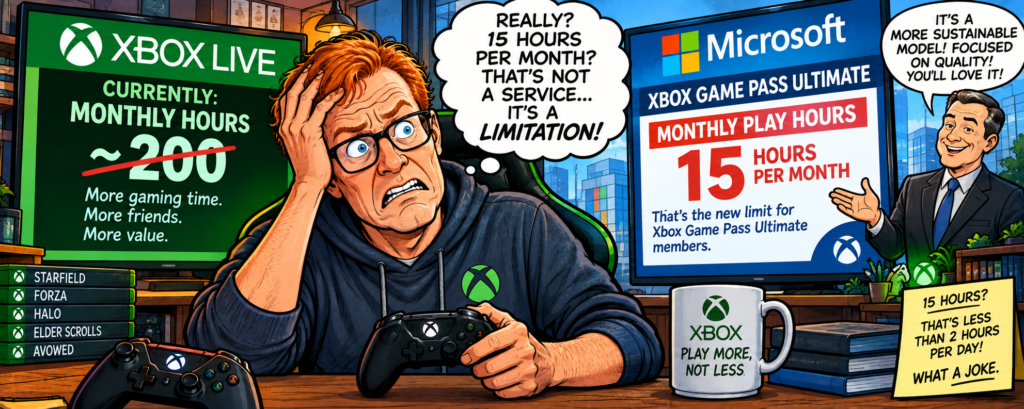
Microsoft has announced new limits on cloud gaming will be introduced in November of this year (Arstechnica). Depending on the Game Pass level you are subscribed to, your monthly hours will drop from “infinite” to as little as 5 hours:
- Game Pass Ultimate: 15 hours/month
- Game Pass Premium: 10 hours/month
- Game Pass: 5 hours/month
This applies strictly to streamed games, where the game itself executes in Microsoft’s cloud infrastructure and your device acts as a display and input device. Microsoft claims that the changes will only “impact” 4% of gamers, suggesting that most Gamepass Ultimate players (for example) use XBox Cloud Gaming less than 15 hours a month. Four percent sounds like a reasonable impact to me given that most gamers are not using cloud gaming and those who do are probably only playing a couple of games using that service, but it doesn’t change my negative reaction to this update in terms.
What is wrong with the change
For years companies like Microsoft and Nvidia have been encouraging gamers to move their playing platform to the cloud. The idea is that gamers can have lower powered devices, perhaps portable devices as an example, and still have access to power-hungry games. They can also play across platforms: for example, play XBox or PC games on a tablet. This seems like a viable tradeoff if the performance is sufficient to emulate what a gamer might achieve on a modest gaming PC or console.
The transition of gamers to cloud based gaming has not generally been a great success. Most players want the best game experience they can afford and they choose to achieve this by having their own dedicated PC or latest generation console for their gaming needs. But some applications, particularly portable gaming devices like the Steamdeck or the various Asus ROG devices, simply can’t match the capabilities of a moderately powerful gaming PC. These devices almost demand cloud-based gaming for some games, and certainly benefit from it.
With a small niche audience of gamers, it feels disingenuous of Microsoft to suggest that they are adding these limits to reduce costs. There are two possible outcomes of this change that occur to me:
- Fewer people will use Xbox Cloud gaming: the price increases will have a chilling effect on usage of the cloud gaming service, pushing people to buy more powerful gaming devices to continue playing the games they want to play. I’m not sure how cloud gaming licensing works, but the shift to stand alone devices might generate a small amount of revenue for Microsoft in new licensing fees
- The people who use it extensively will pay a large premium: people who seriously need to use cloud gaming will be forced to pay extra fees for the extra hours they play beyond those included in the various subscriptions. Microsoft will earn a small amount of extra money from this activity
I am pretty certain that most of the shift will be away from cloud gaming: this won’t help people with portable devices, but it might push some of them onto competing platforms like Geforce Now for their gaming needs. Geforce Now has different licensing requirements and doesn’t grant access to XBox games, but does include 100 hours a month of play time for as little as US$10 a month.
My feeling on this is that Microsoft doesn’t really like XBox Cloud Gaming services or users any more. They want to reduce the audience size below its current levels and squeeze those who remain for a few more dollars. My suspicion is that there will eventually come a point where Microsoft announces that the service is no longer viable and will be shut down. They might even trot out that “only affects 4% of the users” statement when they do. I could be wrong, of course.
Summation
Microsoft seems to be trying to save a small amount of money by harming the experience of some of their best customers. If the hour limits were more reasonable amounts comparable to NVidia Geforce Now I would probably not see a problem with this change. But reducing XBox Live Ultimate from “infinite” cloud gaming usage to 15 hours seems aggressively punitive.
In my opinion, Microsoft is taking a clear stance that cloud gaming is not the business they want to be in. It is causing them some discomfort which, instead of causing them to address it in a competitive manner, is leading them to cut off their foot in order to spite their face. I don’t think they have a strong case for their actions here, even though it doesn’t affect me at all.
The header image for this post is AI generated using ChatGPT. Some of the information in the image is inaccurate, for example the number of hours of Xbox Cloud Gaming which should be “infinite” not 200 hours
15 hours a month is a clear statement they don’t want the business, I think. As you say, GeForce Now gives you 100 hours for the basic subscription (And an excellent service it is, too.) Amazon’s Luna has no limit on played hours at all. It’s a curious move because the current market strongly suggests there’s likely to be a big move by gamers towards cloud gaming services. It’s going to be too expensive for a lot of people to buy their own hardware soon. Or replace what they have. If Microsoft were interested in that market, the last thing they’d be doing would be adding a limit that’s going to exclude almost everyone who self-identifies as a gamer.
It definitely feels like a “market antagonistic” move to me, Bhagpuss. I’m not sitting in the boardrooms, but I’ve done so at different large companies in the past and sort of know how the discussions go. If it is a small amount of business, which it seems to be, you grow to dislike it as an executive as it doesn’t make the line go up in an appreciable way.
Someone on the team says “but some people need this service” and the response is to charge that tiny audience more to make it feel a bit more popular in the boardroom. “There aren’t many people using this, but the handful of users are covering all the costs.” It means little or no investment in the future of the service is being made which, as you say, means they don’t really want the business.